What Is Sight-Singing?
Sight-singing is a fundamental and compulsory subject in most conservatories and music training institutions worldwide. It serves as a foundational discipline that provides students with systematic knowledge of music theory, music reading and notation skills, aural perception, and practical musical expression.
Through sight-singing training, learners develop not only the ability to accurately identify pitch and rhythm but also to enhance musical sensitivity and expressive capacity in performance practice.

Is Sight-Singing Difficult?
Sight-singing is often perceived as a challenging subject among music students. However, its level of difficulty largely depends on learning strategies, consistency in practice, and the learner’s degree of autonomy.
When supported by solid theoretical knowledge, structured pedagogical guidance, and regular practice, students can achieve significant progress. Sustained effort and disciplined training are decisive factors in long-term development.
While musical aptitude may provide an initial advantage, systematic and continuous practice plays a more critical role in achieving professional competency.
Effective Strategies for Learning Sight-Singing
In addition to formal instruction from lecturers, students are encouraged to adopt structured and consistent practice routines. The following approaches are commonly recommended:
Regular reading of exercises from instructional materials to improve reading fluency.
Isolated practice of pitch and rhythm patterns, particularly complex passages.
Continuous training of scales and intervals as essential technical foundations at all proficiency levels.
Separate rhythm practice prior to integrating pitch.
Frequent sight-reading exercises to enhance reflexive musical response and adaptability.
Active listening to diverse musical repertoires to develop aural skills and musical perception.
At advanced levels, sight-singing extends beyond technical accuracy. Learners are expected to convey musical nuance, stylistic characteristics, and expressive qualities inherent in the composition, rather than merely reproducing correct notation.
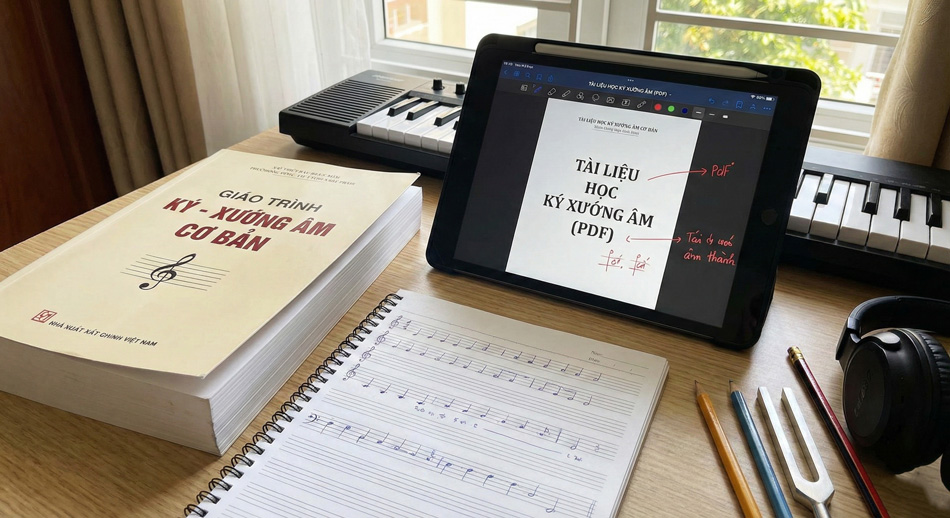
Modes of Instruction
Sight-singing is most effectively studied through direct instruction with qualified lecturers. Additional forms of learning may include:
Group study for collaborative practice and peer evaluation.
Independent study using textbooks and supplementary materials.
Audio recording of practice sessions for self-assessment.
Analytical listening to musical works in both academic and everyday contexts.
A combination of these approaches contributes to improved learning outcomes.
Duration of Study
In professional music education systems, sight-singing is typically taught continuously from elementary to intermediate and university levels. This extended duration reflects its foundational importance and the progressive skill development required in professional music training.
In practice, sight-singing is not limited to a formal academic subject; rather, it constitutes a lifelong competency that accompanies musicians throughout their professional careers.
Conclusion
Sight-singing is a discipline that demands perseverance, structured methodology, and sustained engagement. With appropriate pedagogical guidance and systematic practice, learners can master this essential skill and significantly enhance their musical expertise.
Trương Thị Ngọc Bích